
What Is Monetary Policy?
Monetary policy is the set of actions a central bank takes to influence the amount of money and credit available in an economy. Central banks use tools such as interest rates to adjust the supply of money to keep the economy humming.
The Federal Reserve is the U.S. central bank responsible for U.S. monetary policy. Its monetary-policy mandate is to promote maximum employment and stable prices. To pursue those goals, the Fed influences short-term interest rates through the federal funds rate, which is the rate banks charge each other to borrow overnight.
Where the Major Central Banks Stand Now
The Bank of England lists its current Bank Rate at 3.75%, with the next decision due on 17 September 2026. The Bank of England also lists the current UK inflation rate at 2.9% against a 2% target.
In the euro area, the European Central Bank takes monetary-policy decisions every six weeks to keep inflation at its 2% target. The ECB’s policy framework includes the marginal lending facility, which offers overnight credit to banks against broad collateral at a preset rate.
The Fed’s Recent Policy Shift
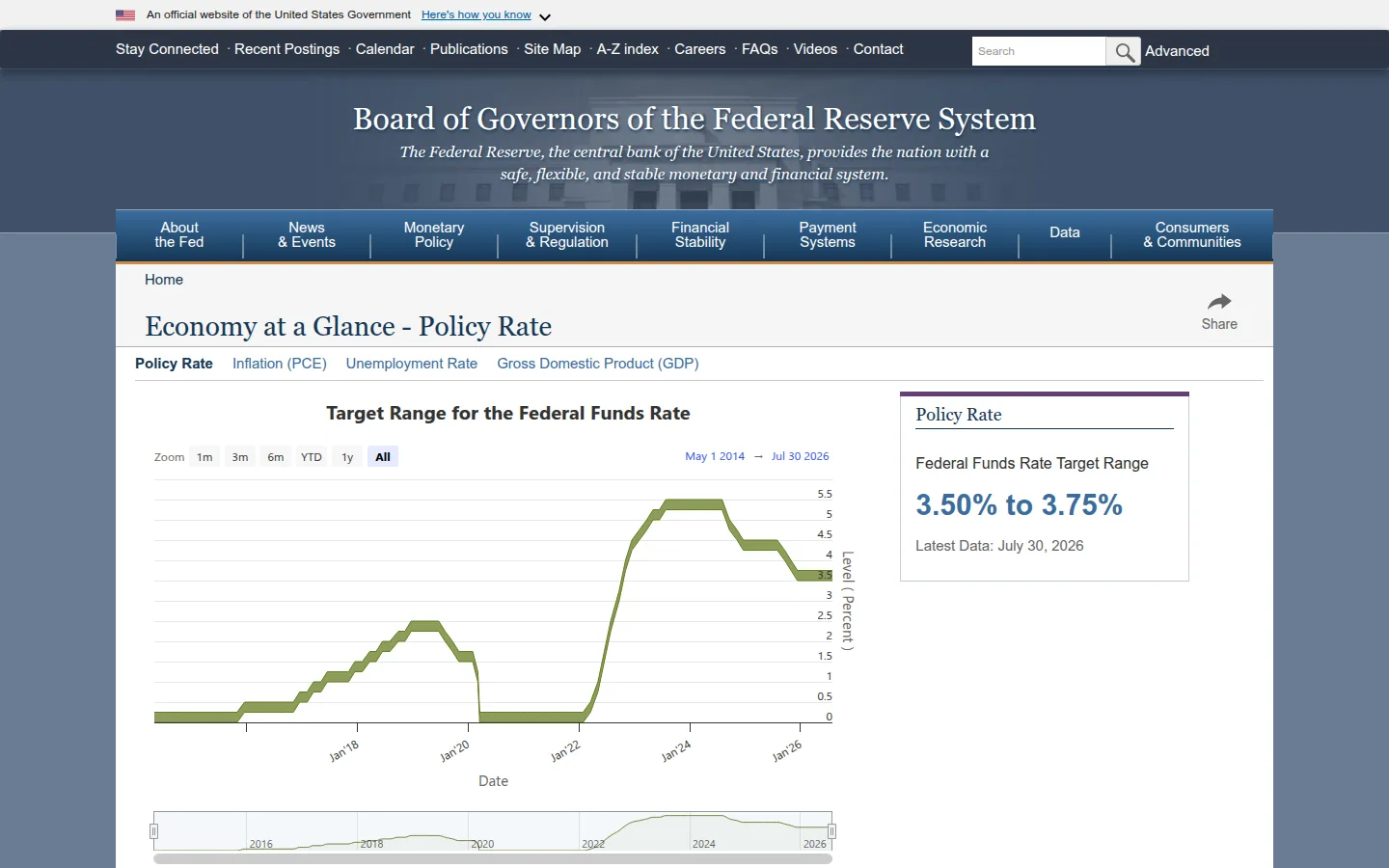
As of July 2024, the Federal Open Market Committee maintained a restrictive stance of policy at recent meetings to keep demand in line with supply and reduce inflationary pressures. Later that year, the Fed lowered the target range for the federal funds rate by a cumulative 100 basis points over its September, November, and December 2024 meetings, bringing it to the current range of 4-1/4 to 4-1/2 percent.
That sequence is a useful example of how a central bank turns a policy view into action: it sets a target range, communicates its reasoning, and adjusts the tools that hold the market rate inside that range.
Tools Central Banks Use
The Fed’s key monetary policy tools include interest on reserve balances (IORB), the overnight reverse repurchase agreement facility, the discount rate, and open market operations. These instruments help the Fed keep the federal funds rate near its target.
Central banks publish their current rates and schedules so the public can track the policy stance. The Bank of England, the European Central Bank, and the Federal Reserve all provide official policy pages with up-to-date figures.
Why Inflation Targets Matter
A 2% inflation target gives households and businesses a clear benchmark. When inflation runs above target, central banks may tighten policy; when it falls below, they may ease. The Bank of England’s current inflation reading of 2.9% is above that benchmark, which is why its Bank Rate remains elevated.
Understanding monetary policy helps you interpret interest-rate news and anticipate how borrowing costs may move. The framework is not static, but the underlying tools are consistent across the major central banks.
What to Watch Next
The next scheduled decision dates are the clearest signals of where policy is heading. The Bank of England’s next decision is due on 17 September 2026. The ECB publishes a decision every six weeks. The Federal Reserve publishes its federal funds rate range and commentary on its policy page.
When those pages change, you are seeing policy adjust in real time. The figures will move, but the framework remains the same: achieve stable prices and maximum employment through transparent, rule-based decisions.